

If you've avoided wheatgrass because you have celiac disease or gluten sensitivity, I want to stop you right there. There's a widespread misunderstanding that needs clarifying, because it might be preventing you from accessing one of the most nutrient-dense plant foods available.
The confusion is understandable. The word "wheat" is right there in "wheatgrass." And wheat = gluten, right? Wrong. And that's an important distinction.
The critical difference: grain vs. grass
Here's the thing that changes everything: wheatgrass comes from a completely different stage of the wheat plant's life than wheat grain does. They're so different that they might as well be different plants.
Wheat grain (where gluten lives): The wheat plant grows, matures, produces grain berries (seeds), and those grain berries are harvested, ground into flour, and used in bread, pasta, and other baked goods. Gluten is a protein in the grain. It's essential to the grain's structure. Gluten is absolutely present in wheat grain.
Wheatgrass (naturally gluten-free): The wheat plant is harvested in its early growth stage—at the "jointing stage," just before the plant flowers and forms grain. At this point, what you're harvesting is the vegetative tissue: the leaves and shoots. There is no grain. There is no gluten. The plant hasn't yet begun to form the structures that contain gluten proteins.
Think of it this way: if you harvested a tomato plant while it was still seedlings, before it ever produced fruit, you wouldn't call those seedlings "tomatoes." They're an entirely different part of the plant's life cycle. Wheatgrass is the same concept. It's the plant before it becomes a grain-bearing crop.
This is a critical distinction because it means wheatgrass is *naturally* gluten-free. It's not processed to remove gluten. It's not that gluten is somehow present but filtered out. Gluten was never part of the plant at that stage of growth.
But testing and safety still matter
That said, natural gluten-free status doesn't mean you can be careless about contamination or processing. Cross-contamination can happen if wheatgrass is grown, harvested, or processed in environments that also handle wheat grain. It's rare, but it's possible.
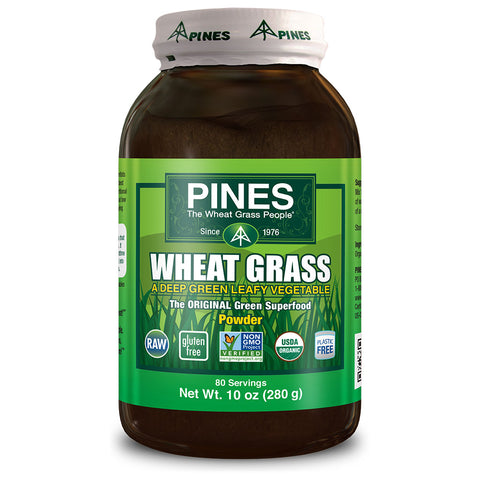
This is why rigorous testing and clear protocols are essential for anyone selling wheatgrass to people with celiac disease or gluten sensitivity. At Pines, we take this seriously. Our wheatgrass products are tested for gluten to ensure that what's in the bottle meets gluten-free standards—not just in theory, but in measurable, verifiable practice.
If you're considering wheatgrass and you have celiac disease or gluten sensitivity, look for products that:
- Are explicitly labeled gluten-free: This means the company has tested and verified the product meets legal gluten-free standards (typically less than 20 parts per million).
- Come from a facility with clear gluten-free protocols: Where is it grown? Where is it processed? Are there safeguards against cross-contamination?
- Have transparent testing documentation: A company should be able to show you their testing results if you ask.
Pines meets all of these criteria. Our wheatgrass is tested, our facilities maintain gluten-free protocols, and we're transparent about our practices.
Who can benefit from gluten-free wheatgrass
- People with celiac disease: If you have celiac, you know that gluten triggers an immune response that damages your small intestine. You need to avoid gluten completely. Tested, gluten-free wheatgrass offers you access to a whole-food, nutrient-dense green that's for everyone.
- People with non-celiac gluten sensitivity: Some people experience adverse reactions to gluten even without having celiac disease (an autoimmune condition). If you're gluten-sensitive, gluten-free wheatgrass is a safe option.
- People choosing to avoid gluten for other reasons: Whether you're following a paleo diet, experimenting with elimination diets, or simply preferring to reduce gluten intake, gluten-free wheatgrass fits easily into that lifestyle.
- Family members and friends of people with celiac: If someone you love has celiac disease, offering them a gluten-free Pines product shows you understand their needs and take them seriously.
The peace of mind factor
One of the things that comes up again and again from people with celiac disease or gluten sensitivity is the anxiety around food. You can't trust most processed foods. You have to ask questions at restaurants. You have to read every label. It's exhausting.
When you find a product that you can trust completely that you don't have to second-guess, it removes a weight. It's not just nutrition—it's peace of mind. It's the ability to say yes to a healthy habit without wondering if it's going to cause you harm.
That's what gluten-free wheatgrass from Pines offers. A whole-food green that supports your digestion, your energy, your long-term health—without the worry.
One more thing: feel confident saying yes
If you've been avoiding wheatgrass because you thought it contained gluten, I want to give you permission to reconsider. The science is clear: wheatgrass, from the right source, tested properly, is naturally gluten-free and completely safe for people with celiac disease or gluten sensitivity.
You don't need to keep searching for "gluten-free approved" greens while you skip over wheatgrass. You can have the original, the most nutrient-dense, the most researched whole-food green—and do it with complete confidence.
That's what knowing the facts enables. It opens up options that were always available but that you didn't know were available to you.



Comments (0)
There are no comments for this article. Be the first one to leave a message!