

50 Years of Staying Power: Why Customers Have Stuck with Pines for Decades
In 1976, two men from Kansas had an idea. They wanted to bring back a nutrient-dense whole food that had nearly been forgotten — wheatgrass, grown the way nature intended, packaged the way science demanded. They didn’t have much money. They didn’t have big investors. What they had was a community of more than 200 people who believed in the mission enough to invest an average of $200 each.
That company was Pines International. And 50 years later, the community is still here.
How It All Started
The story of Pines begins with a man named Ron Seibold. In 1975, Ron was working in an office that stored the remains of Cerophyl — the world’s first multivitamin, created by Dr. Charles Schnabel in the 1930s. Cerophyl was dehydrated whole-food wheatgrass, grown outdoors through Kansas winters and harvested at the peak of nutrition. It had been a phenomenon: nearly every pharmacy in America carried it. But when synthetic one-a-day vitamins hit the market in the 1950s, Cerophyl faded.
Ron started reading the research. He read the testimonials — a file that weighed more than 10 pounds. He started taking the tablets himself and noticed more energy, better digestion, and clearer skin. He became a student of wheatgrass history.
In 1976, Ron and his partner Steve Malone decided to bring wheatgrass back — not as a vitamin, but as what it truly was: a convenient, economical, nutrient-dense dark green leafy vegetable. They called it Pines Wheat Grass, named after the pine tree, an international symbol of peace in nature.
Built by a Community, Not by Corporations
Pines was one of the first examples of crowdfunding — long before that word existed. Instead of finding one or two wealthy backers, Ron and Steve convinced more than 200 people to invest an average of $200 each. The investors didn’t expect to get rich. They believed in organic farming, sustainable communities, and feeding the hungry. They believed in the power of regular people pooling their resources to build something that lasts.
As the founders liked to say: “One pine tree does not a forest make.” In a forest, each tree grows tall, but none grows alone. That philosophy has guided Pines for half a century.
The First Customers
After their first harvest, Ron and Steve shut down the office and hit the road. They stayed at campgrounds at night and pitched Pines Wheat Grass to natural food stores by day. Their first sale: six bottles to a store in Denver. Their second: 24 bottles to Margaret Isley at the original Vitamin Cottage in Lakewood, Colorado — a woman who went on to become a leader in the natural foods industry. Her family now owns nearly 100 Natural Grocers stores nationwide.
By the end of their travels in 1977, more than 2,000 stores in 35 states carried Pines Wheat Grass. Pines was the first product in what became the “green food section” of Whole Foods and other natural food stores.
Why Customers Stay
Fifty years is a long time in any industry. In the natural foods world, brands come and go every year. So why do customers keep coming back to Pines?
1. Consistency You Can See
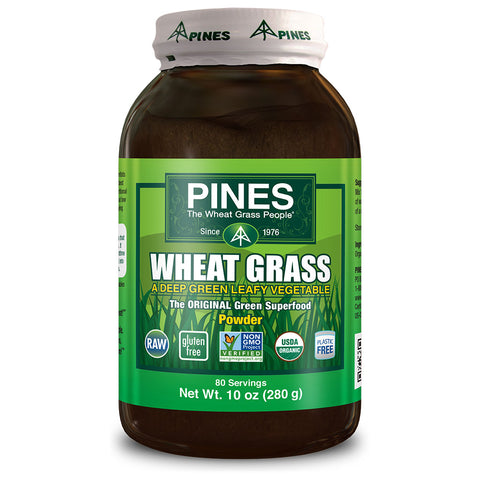
Pines Wheat Grass is a deep, vibrant green. That’s not an accident. It’s the result of growing wheatgrass outdoors through nearly 200 days of Kansas winter, in glacial soil, fed by natural rainfall. The darker green the vegetable, the more chlorophyll, vitamins, and phytonutrients it contains. Customers who’ve tried other brands often come back to Pines because they can see — and taste — the difference.
2. Standards That Haven’t Changed
Pines still follows the standards Dr. Schnabel established in 1937. That includes harvesting at the jointing stage — the brief, once-a-year window when nutrient density peaks. It includes low-temperature drying. And it includes packaging in oxygen-free amber glass bottles with special metal caps, the same method Schnabel designed to prevent oxidation. Pines is still the only green superfood company to use this packaging.
3. A Whole Food, Not a Juice
As the wellness world swung toward juice cleanses and wheatgrass shots, Pines held its ground. The research — from Dr. Reuben in the 1970s to more recent studies — consistently shows that whole foods, with their fiber intact, are what support digestive health. Pines Wheat Grass is prebiotic. Juice is not. Customers who understand this difference have stayed loyal for decades.
4. A Mission Beyond the Product
Pines has donated several million dollars worth of wheatgrass to feeding programs for malnourished people. The company has contributed hundreds of thousands of dollars to environmental and organic farming causes. It has converted more than 2,000 acres of land to organic farming and helped other farmers convert 2,000 more. Customers don’t just buy a product — they support a mission.
The Athletes Who Trust Pines
Elite athletes have been part of the Pines story for decades. Hobie Call, a four-time Spartan Race World Champion, has used Pines throughout his entire racing career. He’s won more than 50 races and says: “I contribute more to your products than anything else I eat. I have used your Wheat Grass for many years and intend to continue for many more.”
Joe Kauder, an ultra marathoner who finished a 100-mile race in over 28 hours, relies on Pines. Sam Zehnder, a competitive weightlifter, calls Pines “an excellent addition to my supplements shelf.” Personal trainers, boxers, triathletes, and marathon runners have all made Pines part of their daily routine.
When people push their bodies to the limit, they choose whole foods they can trust. That trust has been earned over 50 years.
50 Years and Counting
The wellness industry has changed dramatically since 1976. Fads have come and gone. Juice bars rose and declined. Superfood blends filled shelves with filler ingredients. Through it all, Pines has done the same thing it’s always done: grow real wheatgrass, the right way, and package it to preserve every bit of nutrition.
The customers who found Pines in 1977 are still here. Their kids grew up on it. Their grandkids are starting on it now. That’s not marketing. That’s a half-century of trust.
Here’s to the next 50 years. And to every pine tree in the forest.
Join the community that’s been growing for 50 years. Shop Pines Wheat Grass and become part of the story.



Comments (0)
There are no comments for this article. Be the first one to leave a message!