

In July 2026, the United States turns 250 years old—and right alongside that national milestone, a small Kansas-born greens company is quietly celebrating 50 years of its own. One marks a quarter-millennium of independence, the other marks half a century of sticking to a simple mission: grow real food the right way and make it easy for people to eat their greens every day.
From 1776 to 1976: Two very different revolutions
In 1776, a group of people gathered to sign a document that would change the course of history. The American Revolution wasn’t about shortcuts; it was about hard choices, long-term vision, and a belief that ordinary citizens could build something better over time.
Exactly 200 years later, in 1976, two Kansas founders—Ron Seibold and Steve Malone—signed a very different kind of commitment. They started Pines with just a few thousand dollars, an old gym for an office, and a belief that nutrient-dense cereal grass could help people feel and live better if it was grown and handled with integrity. While the rest of the wellness world chased fads, they chose a harder, slower path: organic farming, once-a-year harvests, and glass bottles instead of cheap plastic.
In both stories, the theme is the same: commit to something bigger than a quick win and stay with it.
A 250‑year experiment in independence, a 50‑year proof in real food
America’s 250th is a reminder that independence isn’t just a date on a calendar—it’s something you maintain through daily choices. What you eat, what you support, and what you bring into your home are all quiet “votes” for the future you want.
Pines was built on that same kind of everyday decision-making. Ron and Steve didn’t launch a synthetic multivitamin or a trendy detox powder; they revived decades of wheatgrass research and brought it back as what it had always been at its core: a dark green vegetable grown in real soil and dried at low temperatures to keep its natural nutrients and fiber intact.
Instead of chasing lab-made shortcuts, they followed the science from the 1930s to the 1970s that showed cereal grasses, grown slowly through cold weather and harvested at the short “jointing” window, could deliver concentrated levels of vitamins, chlorophyll, and phytonutrients. In other words, they bet on food.
From counterculture to mainstream: greens grow up
If you walked into a natural food store in 1976, there were no influencer-branded greens blends, no neon detox shots in plastic tubs. Taking a dark green vegetable in tablet or powder form looked a little strange—countercultural, even.
Pines was one of the brands that helped shift greens from “unusual” to “essential.” Over five decades, the same Kansas farm has grown wheatgrass through long, cold seasons in glacial soils, harvested it once a year at peak nutrition, and dried it gently before packing it in oxygen-free amber glass bottles. Those choices are why you still see that rich, vibrant green when you open a bottle today.
Meanwhile, American food culture has changed dramatically. From TV dinners to fast-casual bowls, from low-fat to low-carb to keto and back again, one message has remained steady in the research: people who eat more green, leafy vegetables tend to do better over the long term. Pines has spent 50 of the country’s 250 years making that simple habit easier.
The original wheatgrass lab and America’s ongoing experiment
As the U.S. moved through its second century, a quieter experiment was unfolding on a Kansas farm and in a small laboratory. In the 1930s, agricultural chemist Dr. Charles Schnabel and his team discovered that when wheatgrass was grown outdoors through winter and harvested at a specific spring jointing stage, it contained higher concentrations of many vitamins than typical vegetables.
That research led to Cerophyl, the world’s first multivitamin made entirely from cereal grass, which was prescribed by doctors and used in hospitals long before “superfood” became a marketing term. Decades later, Pines purchased the very farm, lab, and dehydrator where Schnabel’s work took place—literally inheriting the birthplace of cereal-grass science.
Owning that original farm and lab means Pines can trace today’s products directly back through 90-plus years of wheatgrass research and 50 years of continuous production. In a world where many products are built for quarterly trends, that kind of continuity is rare.
50 years of staying power in a 250‑year country
There’s a reason Pines is still here after 50 years:
- The same Kansas glacial-soil region continues to grow the wheatgrass, with seeds planted in fall and allowed to mature slowly through cold weather for about 200 days.
- Harvest happens only once a year, during a brief 3–5 day window at the jointing stage, when chlorophyll, protein, and vitamins peak.
- The grass is dried at low temperatures and kept as a whole food, preserving prebiotic fiber for gut health instead of stripping it out like a juice.
- The finished powders and tablets are packaged in oxygen-free amber glass bottles using nitrogen-flush systems first improvised with a blacksmith-built box in Hays and refined over time at the Schnabel facility near Lawrence.
Those choices aren’t the fastest or cheapest way to make a greens product, but they are why customers have used Pines for years, even decades, as a baseline way to “get their greens in” every single day.
As America celebrates 250 years of an ongoing national project, Pines is celebrating 50 years of an ongoing nutrition project: proving that simple, consistent choices add up over time.
Celebrate red, white, and green: July 3–5 sale (up to 50% off)
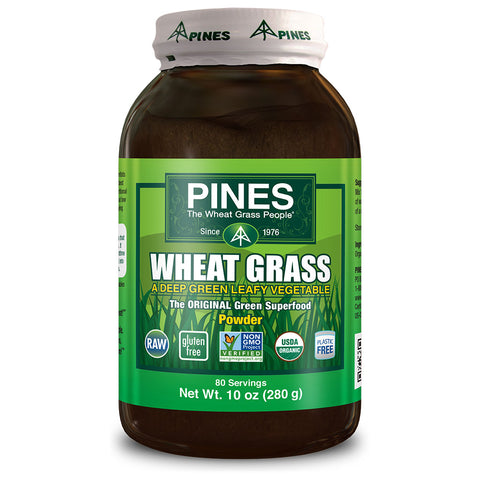
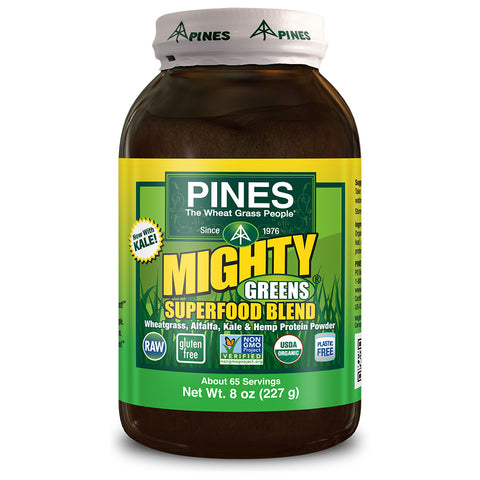
To mark both the USA’s 250th anniversary and Pines’ 50th anniversary, Pines is offering customers up to 50% off all products on our website from July 3–5, 2026.* It’s a chance to stock up on your favorite greens—or start a daily greens habit—at some of the best prices of our anniversary year.
Whether you’re grilling with family, road-tripping to see fireworks, or just taking a long weekend to reset, adding a serving of Pines to your day is a simple way to honor the idea that independence also means taking ownership of your health.
- Seven tablets or a rounded teaspoon of powder deliver the nutrition of a serving of dark green leafy vegetables—without chopping, cooking, or food waste.
- Glass bottles and organic farming mean you’re choosing greens that respect the land we’re celebrating on July 4.
- Whole-food fiber and chlorophyll make Pines an easy daily addition for gut health, energy, and long-term wellness.
This Independence Day weekend, you can celebrate the country that made room for small, values-driven farms and the small company that spent 50 years keeping one simple promise: real greens, grown right, in every bottle.
Get ready for our July 3–5 anniversary sale with up to 50% off all products on our website. Choose the greens you want to keep on hand this summer, and make 2026 the year you commit to a daily green ritual that lasts long after the fireworks fade.
*Offer valid online only July 3–5, 2026. Exact discounts and availability may vary by product.



Comments (0)
There are no comments for this article. Be the first one to leave a message!