

Every company has a beginning. Ours starts with two friends, eight thousand dollars, and a quiet conviction that more people needed to eat their greens.
The year was 1976. America was celebrating its bicentennial. The Vietnam War had just ended, and a lot of people were feeling disillusioned with the system. Into that moment stepped Ron Seibold and Steve Malone — two men who believed the pure spirit of free enterprise and cooperation was still alive, and set out to prove it with a jar of wheat grass.
It Started With a Book and a Bottle of Tablets
A year earlier, in 1975, Ron was working in an office that stored the remains of a once-famous product called Cerophyl. Back in the 1930s and 1940s, Cerophyl was the world’s first multivitamin — dehydrated whole-food wheatgrass, grown and studied by an agricultural chemist named Dr. Charles Schnabel. By the 1970s, synthetic one-a-day pills had nearly wiped it out. All that was left was a filing cabinet, some literature, and a few cases of tablets in cold storage.
Ron started reading. He spent months studying the medical research and the sales history of Cerophyl. He started taking the tablets himself and noticed more energy, better digestion, and clearer skin. He became a student of wheatgrass history.
Ron had grown up on a farm in northeastern Kansas. He already knew, from boyhood, what spring wheatgrass could do. His father and other farmers pastured their cattle on wheatgrass in the spring, at the jointing stage, and it was common knowledge that it brought health to tired animals and boosted their milk production. Ron remembered chewing the leaves as a boy and feeling a rush of energy.
Two Friends Make a Promise
In 1976, Ron met Steve Malone in Hays, Kansas. The two men promised each other they would commit to the vision and make a new company real. They wouldn’t market it as a vitamin — that message had stopped working. Instead, they would reintroduce dehydrated wheatgrass as what it truly was: a convenient, economical, nutrient-dense dark green leafy vegetable, full of the fiber the modern diet was missing.
Rather than chase a single wealthy backer or a bank, they turned to ordinary people. Steve, a lifelong resident of Hays, lined up most of the investors. Together, the two men convinced more than 200 people to invest an average of $200 each. Most didn’t expect to get rich. They believed in organic farming, in supporting charitable programs, and in the idea that a community of small investors could build something lasting.
$8,000 and a Dream
Ron and Steve started the company with $8,000 in cash from some of the original stockholders. The rest received stock in return for services. Employees were paid in stock. The farmer and the dehydration company took stock instead of money. It was, in its own way, an early example of crowdfunding — long before that word existed.
They chose the name “Pines” after the pine tree, an internationally recognized symbol of the peace that exists in nature. There’s an old saying: “One pine tree does not a forest make.” Another: “In a forest, each pine tree grows tall to keep out of each other’s shadows.” The investors, employees, and customers were like trees in that forest — each unique, each part of something bigger, growing strong not because of one person but because of the cooperative effort of all.
Hitting the Road
After that first harvest, Ron and Steve shut the office down and moved it into the home of two stockholders, who handled shipping and answered the phone. Then the two founders hit the road.
They stayed at campgrounds at night and used the campground showers and bathrooms to get ready for the day. At first, they tried a multi-level marketing model. After two weeks, it was clear the plan was moving too slowly, and bills were piling up. They had to change course.
On a whim, they walked into a health food store in Denver. The owner bought six bottles. Their next stop was the original Vitamin Cottage in Lakewood, Colorado. There, the owner, Margaret Isley, befriended the pair, shared what she knew about the natural food industry, and bought 24 bottles. She went on to become one of the great leaders of the natural foods movement. Her family now owns nearly 100 Natural Grocers across the United States.
Inspired by Margaret’s guidance, Ron and Steve went store to store across Denver. Most had never heard of wheatgrass, but they understood the simple message: eat more dark green leafy vegetables. Within days, they’d sold enough to convince a Colorado natural foods distributor to carry Pines Wheat Grass. They repeated that pattern for the next eight months. By the end of their travels in 1977, more than 2,000 stores in 35 states carried Pines Wheat Grass — including the small chains that would later merge to become Whole Foods Market. Pines Wheat Grass was the first product in what became the “green food section” of those stores.
Back to Schnabel’s Land
There’s a beautiful twist in this story. The men had forgotten that wheatgrass history began near Lawrence, Kansas. In 1984, while looking for a place to put new equipment, they toured an old alfalfa processing plant at a place called Midland Corners outside Lawrence. The plant had been shut down for five years. On the wall, they spotted an old black-and-white photograph that read “Cerophyl Laboratories.” They nearly shouted with joy — they were standing in the very building that housed a laboratory Dr. Schnabel had used at the dawn of wheatgrass history. They bought the historic facility, and to this day Pines still uses that lab and many of those same fields.
The Same Standards, 50 Years Later
Today, Ron, Steve, the 200 shareholders, and every employee are still fulfilling the vision that began in 1976. Pines has converted more than 2,000 acres of land to organic farming and helped other farmers convert 2,000 more. The company has donated millions of dollars worth of wheatgrass to feeding programs for malnourished people, and hundreds of thousands of dollars to environmental and organic farming causes.
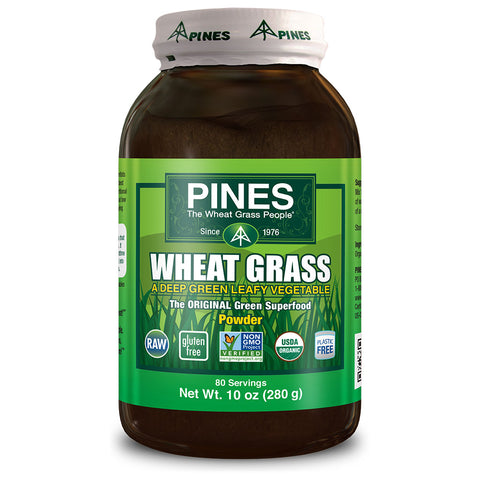
The growing standards haven’t changed. Pines Wheat Grass still grows outdoors in the glacial soils of northeastern Kansas, through nearly 200 days of slow winter growth, fed only by natural rainfall. It’s harvested at the jointing stage — the peak of nutrition — and packaged in oxygen-free amber glass bottles with the special metal caps Dr. Schnabel designed in 1937. Certified Organic, Non-GMO Project Verified, gluten-free, Kosher.
The message hasn’t changed either. It’s the same one Ron and Steve proclaimed in 1976: eat more greens.
A Forest, Still Growing
Fifty years on, that pine forest is still growing. Every bottle of Pines Wheat Grass carries the work of two friends, 200 investors, a farmer’s son, a scientist’s legacy, and a simple idea that turned out to be exactly right: that whole-food greens, grown the way nature intended, belong in every kitchen.
We’re proud to carry it forward.
Curious where it all began? Shop Pines Wheat Grass — the same whole-food greens, grown the same way, since 1976.



Comments (0)
There are no comments for this article. Be the first one to leave a message!