

When you mix a serving of wheatgrass into water today, it might feel like a modern wellness ritual. But the story behind that green goes back nearly a century—to farm fields, lab notes, chickens, and early medical journals.
Pines sits at the intersection of that history: more than 90 years of wheatgrass research and 50 years of turning that science into everyday, accessible greens. Here’s how we got from hand‑written lab notebooks to social‑media feeds—and why that scientific legacy still matters for you.
1930s: Farm experiments that changed everything
It started with a simple question on a Kansas farm: what happens if animals get more of the young, leafy stage of cereal grasses? Researchers noticed that chickens fed these greens were healthier and produced more eggs than those on standard feed. That sparked deeper investigation into what made these grasses so powerful.
Scientists began documenting improvements in fertility, growth, and resilience in livestock when cereal grass was included, indicating the plants contained concentrated, biologically important nutrients. These findings led to the development of early cereal‑grass supplements, making wheatgrass one of the earliest “green superfoods” backed by formal science.
Mid‑century: Synthetic vitamins rise, greens go quiet
As synthetic vitamins became popular, many people shifted away from food‑based supplements. Cereal‑grass products faded from shelves, and wheatgrass moved out of the spotlight. But the underlying research never stopped being true: whole‑food greens were still nutrient‑dense, still powerful, and still linked to better health outcomes.
For decades, the farm fields used for wheatgrass research continued to grow nutrient‑rich cereal grasses, maintaining soil quality and farming practices even when the market wasn’t focused on greens. That continuity is part of what makes Pines unique today: the same land, the same farming philosophy, and an unbroken line back to those early experiments.
1976: Pines brings wheatgrass back
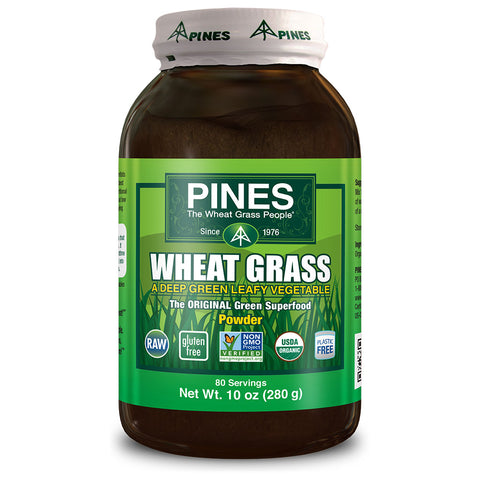
In 1976, Pines re‑introduced wheatgrass as a simple, whole‑food greens supplement rooted in that original science. Instead of chasing trends or adding fillers, the founders focused on capturing the nutrient density of cereal grass at its peak and delivering it in easy forms—powder and tablets—people could use daily.
They kept the original farming standards: organic practices, glacial soils, rain‑fed fields, and the critical jointing‑stage harvest window when nutrition peaks. That commitment gave Pines a strong scientific backbone—less about marketing language, more about consistent, measurable quality.
The jointing stage: a tiny window with big impact
One of the most important findings in wheatgrass science is that nutrient levels aren’t static; they rise and fall as the plant grows. At the jointing stage, when the plant shifts from leaf growth toward forming a stem and eventual grain, its concentration of vitamins, minerals, and chlorophyll reaches a high point.
Researchers learned that harvesting within a tight 3–5‑day window around jointing preserves those peak levels. Harvest too early, and the grass hasn’t built up its full nutrient potential; harvest too late, and energy shifts into the developing grain instead of the leaves. Pines structures its entire farming and processing schedule around that brief window, then dries and packages the grass to lock in the science‑driven nutrition.
Modern science: greens, gut health, and long‑term wellness
Today’s research on leafy greens and whole foods continues to reinforce what those early wheatgrass experiments suggested. Higher intake of green vegetables is linked with better cardiovascular health, improved gut function, healthier weight management, and reduced risk of several chronic diseases.
Wheatgrass, as a concentrated dark green food, provides fiber, chlorophyll, and antioxidants that feed the microbiome, support circulation, and assist the body’s natural detox pathways. While no single ingredient is a cure‑all, consistent greens intake is one of the most evidence‑backed habits for long‑term wellness.
From lab notebooks to your daily ritual
What used to live in farm ledgers and lab notebooks now shows up in simple, everyday routines: a scoop of wheatgrass in water at your desk, tablets with your morning coffee, or a green boost in your smoothie. The decades of science behind that habit means you’re not just following a trend—you’re tapping into an enduring, tested way of eating more greens.
Pines’ history is really about continuity: keeping the same farm, the same standards, and the same single‑ingredient focus so you can trust that your greens are backed by more than just marketing claims. Every bottle is the result of nearly a century of learning how to grow, harvest, and protect wheatgrass at its scientific best.



Comments (0)
There are no comments for this article. Be the first one to leave a message!