

When people talk about wellness, they usually focus on the obvious: energy, immunity, fitness. But there’s an unsung hero that doesn’t get nearly enough attention — and it’s working behind the scenes every single day.
Your colon.
It’s not the most glamorous topic. But if your digestive system isn’t functioning well, nothing else feels quite right either. And the key to a healthy colon? It’s simpler than you might think: whole-food fiber.
Why Colon Health Matters
The colon — also called the large intestine — is where your body processes what’s left after digestion. It’s home to trillions of bacteria, including the “friendly” probiotic bacteria that help your body absorb nutrients and maintain digestive health.
For those bacteria to thrive, they need food. That food is fiber — specifically, the fiber found in whole foods. Fiber that feeds probiotic bacteria is called prebiotic. Without enough prebiotic fiber, the friendly bacteria can’t grow, and the digestive system doesn’t function the way it should.
Here’s the connection: a healthy colon helps your body support natural digestive processes. When fiber is missing from your diet, that process slows down. Dr. David Reuben highlighted this in his 1975 book The Save Your Life Diet, where he showed that cultures eating whole foods rich in fiber had better digestive health than those eating processed, low-fiber diets.
The Problem with Juices
Here’s where a lot of wellness advice gets it wrong: juicing.
When you extract juice from a fruit or vegetable, you remove the fiber. Without fiber, juice passes through the digestive system too quickly to nourish the probiotic bacteria that live there. Whole foods with their fiber intact provide the prebiotic environment that beneficial bacteria need.
Juices also tend to have a higher glycemic index than whole foods. That means they can cause blood sugar to rise quickly, rather than providing the slow, steady energy that comes from whole-food fiber.
The takeaway: juices have their place, especially mixed with whole foods. But they are not prebiotic. Whole foods — with their fiber intact — are what your colon actually needs.
What Makes a Food Prebiotic?
A prebiotic food is one that contains the fiber needed to feed probiotic bacteria. Not all fiber-rich foods are created equal, but dark green leafy vegetables are near the top of everyone’s list.
Here’s why: dark green leafy vegetables contain both fiber and chlorophyll. The combination of fiber and chlorophyll creates the environment that probiotic bacteria need to grow. That’s why whole-food greens — not juices — are so important for digestive health.
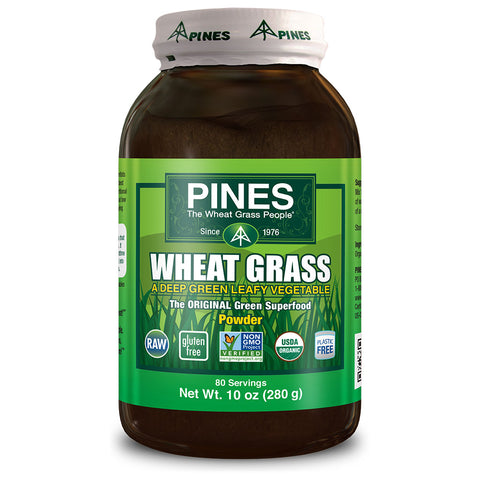
Pines Wheat Grass is a whole food. It’s not a juice. The natural vegetable fiber is still intact, which makes it prebiotic. When you add a teaspoon of Pines powder to a smoothie, or take seven tablets with water, you’re giving your digestive system the fiber it needs to support those friendly bacteria.
The Tablet Swelling Demo: See the Fiber in Action
Here’s a simple experiment that shows exactly what whole-food fiber does. Place a Pines Wheat Grass tablet on a plate. Add a few drops of water. Watch what happens.
The tablet instantly turns dark green. Over the next ten minutes, it swells to 12 times its original size.
That’s the fiber at work. The same expansion happens in your digestive system — the fiber absorbs water, creates bulk, and gives the colon what it needs to function properly. Imagine the amount of finely chopped green vegetables in a seven-tablet serving. That’s the green food nutrition equivalent to a large spinach salad — with all the fiber and chlorophyll intact.
Try it yourself. It’s one of the most visual demonstrations of why whole foods matter.
The Fiber Most of Us Are Missing
The CDC reports that 9 out of 10 Americans don’t eat enough vegetables and fruits. The USDA’s MyPlate guidance recommends that vegetables — especially whole-food vegetables, not juice — should be the most abundant food in our diets. Yet most of us are falling far short.
When fiber is missing from the diet, the colon doesn’t get what it needs. The friendly bacteria don’t have food. Digestive function slows. And the overall sense of wellness that comes from a healthy, functioning digestive system fades.
Pines Wheat Grass makes it easy to add whole-food fiber back into your day. One rounded teaspoon of powder or seven tablets gives you the nutrition of a serving of dark green leafy vegetables — with all its prebiotic fiber. For less than 50 cents a serving.
“Being Green Inside Is Being Clean Inside”
There’s an old adage: “Being green inside is being clean inside.” It’s not just a catchy phrase. It reflects the reality that whole-food, chlorophyll-rich greens with their natural fiber are essential for a healthy colon — and a healthy colon is essential for overall wellness.
The body’s natural processes work best when supported by adequate fiber and whole-food nutrition. Whole-food greens, with their fiber and chlorophyll, support that process. Juices — stripped of their fiber — do not.
A Labor Day Wellness Reset
Labor Day marks the unofficial end of summer. It’s a natural checkpoint — a moment to reset before fall routines take hold. If you’ve been meaning to focus on your digestive health, this is the perfect time.
Start with a daily serving of whole-food greens. A teaspoon of Pines Wheat Grass in a smoothie. Seven tablets with breakfast. Either way, you’re getting the prebiotic fiber your colon needs, along with chlorophyll, vitamins, and minerals — all from a whole food, not a juice.
Your colon has been quietly working for you every day. Give it the fiber it needs to keep doing its job.
Ready to support your digestive health with whole-food greens? Shop Pines Wheat Grass and make fiber part of your daily routine.



Comments (0)
There are no comments for this article. Be the first one to leave a message!